Usage
Start
After installation TLP will start automatically on boot. To avoid having to restart the system the first time, you can start it manually by using the shell command:
sudo tlp start
Note
Also use this command to apply changes after editing the configuration
(Re-)starting tlp.service is not the best choice for this purpose; see the FAQ
Profile Switch
As of version 1.9 TLP supports three profiles: performance, balanced and power-saver. They can be automatically switched when changing from AC to battery power and vice versa, or with a mouse click on your favorite desktop:
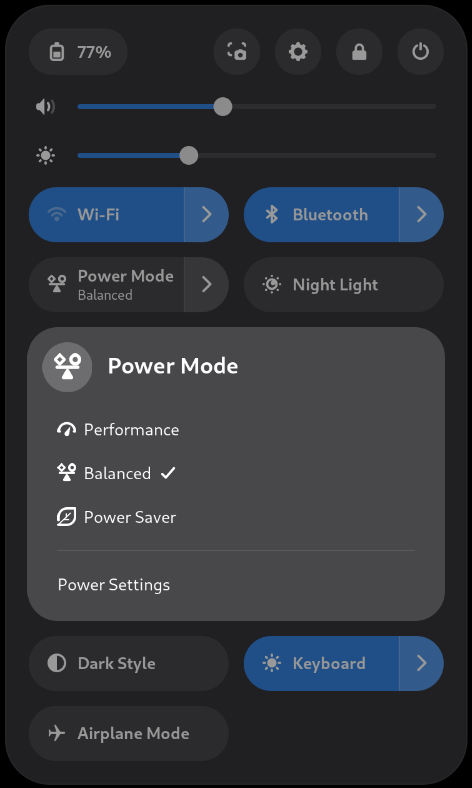
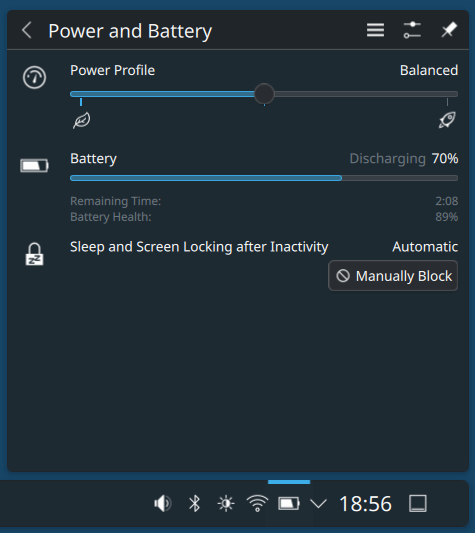
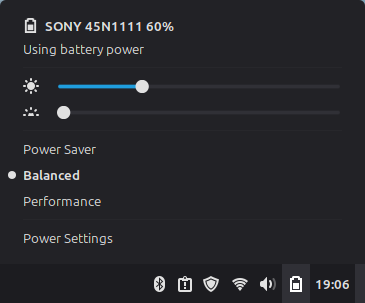
Alternatively, you can switch using a shell command (see below).
Status
To verify that TLP is enabled and active use the shell command:
tlp-stat -s
Check the output for
+++ TLP Status
tlp            = enabled, last run: <Time of system start or last change of profile>
tlp-rdw        = enabled
tlp-pd         = enabled, running
TLP profile    = balanced/BAT
Power source   = battery
Note
It is not recommended to use systemctl status tlp.service for this purpose, as tlp.service is only used during system startup and exits afterward. tlp-stat -s provides a plausible and complete status including tlp-pd.
Version
This shell command shows TLP’s version:
tlp --version
Version 1.6.1 and older: check the first output line of tlp-stat -s.
Commands
The following sections describe TLP’s set of shell commands:
Note
All commands shown with a preceding sudo may as well be executed without sudo in a root shell
For even more details refer to the command’s manpage: man <command>